What Is Laser Drilling?
Laser drilling for glass and optical substrates is a non-contact micro-machining process in which a tightly focused laser beam ablates material along the z-axis to produce through-holes, blind holes, and tapered vias with diameters ranging from a few microns to several hundred microns. Unlike mechanical CNC drilling, which is limited by tool diameter and rigidity, laser drilling has no physical tool — the focused spot size determines the minimum hole diameter, enabling features far below what any mechanical drill can achieve. Three primary laser drilling strategies are used depending on hole geometry and substrate: single-pulse percussion drilling (fastest, for small shallow holes), multi-pulse trepanning (for larger or deeper holes with controlled wall quality), and helical drilling (for the finest wall finish and tightest diameter tolerance). Ultrafast picosecond and femtosecond lasers deliver cold ablation with negligible heat-affected zones, producing clean, crack-free hole walls even in brittle materials such as sapphire, fused silica, and glass-ceramic. Through-glass via (TGV) arrays for advanced semiconductor packaging are among the most demanding applications, requiring thousands of precisely positioned holes with diameter tolerances within ±2 µm.
Process Capabilities
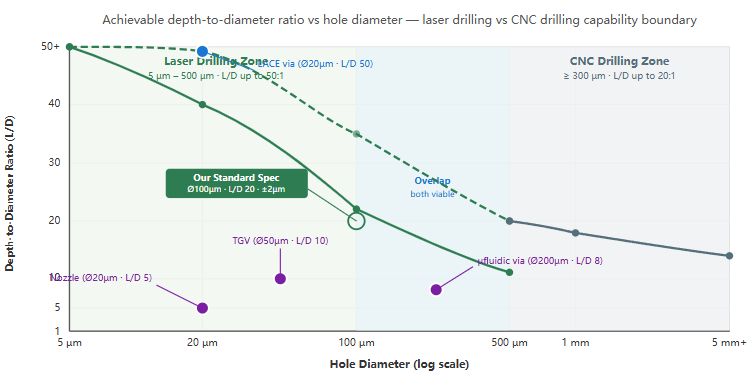
- Hole Diameter Range: 5 µm – 500 µm (laser); complementary to CNC drilling (≥ 300 µm)
- Diameter Tolerance: ±2 µm (precision trepanning); ±5 µm (standard)
- Positional Accuracy: ±2 µm across full substrate
- Depth-to-Diameter Ratio: Up to 50:1 (percussion + trepanning combined)
- Hole Types: Through-hole, blind hole, tapered via, non-circular (slot, square, custom)
- Wall Roughness (Ra): 0.5 – 2.0 µm (as-drilled); ≤ 0.2 µm (post-etched)
- Maximum Array Density: Pitch down to 50 µm center-to-center
Compatible Materials
| 1 | Fused Silica | Corning 7980 / Tosoh ES-2000 |
| 2 | Quartz Glass | SCHOTT Lithosil Q / Heraeus Suprasil 1 |
| 3 | Borosilicate Glass | PYREX 7740 / BOROFLOAT 33 |
| 4 | Soda-Lime Glass | Float / Tempered |
| 5 | Sapphire | C-plane / A-plane |
| 6 | Glass-Ceramic | ZERODUR / PYROCERAM 9606 |
| 7 | Optical Glass | BK7 / N-BK7 |
| 8 | Silicon | Float Zone / Czochralski |
| 9 | CaF₂ | UV-grade / IR-grade |
| 10 | Coated Glass | ITO / AR / metal-coated substrates |
| 11 | Technical Ceramics | Al₂O₃ / AlN / Si₃N₄ |
Drilling Strategy Selection
- Percussion Drilling: Single or multi-pulse on-axis ablation — fastest cycle time, best for Ø < 50 µm shallow holes, slight taper inevitable
- Trepanning: Laser spot orbits a circular path — better wall quality, tighter diameter tolerance, suitable for Ø 50 – 500 µm
- Helical Drilling: Spiral toolpath with z-feed — finest wall finish (Ra ≤ 0.5 µm), best for high-aspect-ratio precision vias
- LACE (Laser + HF Etch): Laser pre-modification followed by chemical etching — ultra-smooth walls, aspect ratio up to 100:1
- Strategy Selection: Percussion for speed · Trepanning for size control · Helical for quality · LACE for extreme AR
Typical Applications
- Through-Glass Vias (TGV): High-density via arrays in glass interposers for advanced semiconductor packaging
- Microfluidic Vias: Inlet/outlet through-holes in bonded glass microfluidic chips
- Inkjet Nozzle Plates: Precision orifice arrays in fused silica and silicon for inkjet and dispensing heads
- MEMS Devices: Etch-access holes and release vias in glass MEMS substrates
- Optical Fiber Ferrules: Precision bore holes for single-mode fiber alignment in glass ferrule blanks
- Aerospace Sensors: Pressure port holes in sapphire and fused silica sensor windows
Custom Specifications
We accept custom laser drilling orders based on DXF, GDS-II, or customer-supplied coordinate files, supporting both single-hole prototypes and high-density array production with thousands of holes per substrate. Custom parameters include hole diameter, depth, taper angle, wall quality grade, and drilling strategy selection. For through-glass via applications, we offer integrated workflows combining laser drilling with electroless copper seeding, via filling, and CMP planarization. Post-drilling services — including HF smoothing, ultrasonic cleaning, optical inspection, and CMM positional verification — are available as part of a complete processing package. All drilled substrates are delivered with hole diameter maps, positional accuracy reports, and full material traceability.
Laser Drilling Capability: Hole Diameter vs Aspect Ratio