What Is UV Adhesive Bonding?
UV adhesive bonding is an optical assembly technique in which two components are joined using a thin layer of UV-curable optical cement that hardens within seconds when exposed to ultraviolet light. Unlike thermal or two-part adhesives, UV cements remain liquid until deliberately cured, giving assemblers unlimited working time for precision alignment before triggering the curing reaction with a controlled UV exposure. Modern optical-grade UV cements — such as Norland NOA series, Dymax OP series, and EpoTek OG cements — offer refractive indices closely matched to common optical glasses, excellent transparency from 400 nm to 2000 nm, and long-term dimensional stability. UV bonding is the industry standard for high-volume production of cemented doublets, prism assemblies, fiber arrays, and optical modules where speed, precision, and repeatability are essential.
Process Capabilities
- Bond Line Thickness: 5 – 50 µm (standard); 50 – 200 µm for gap-filling applications
- Alignment Accuracy: ±2 µm translational / ±10 arcsec angular
- UV Cure Time: 5 – 30 seconds (primary cure); post-bake optional for full strength
- Bond Strength: 10 – 30 MPa (shear); 15 – 40 MPa (tensile)
- Transmitted Wavefront Error: λ/4 – λ/10 (cement-dependent)
- Operating Temperature Range: –55 °C to +125 °C (standard cements)
- Refractive Index Range: nd = 1.45 – 1.60 (index-matched formulations available)
Compatible Materials
| # | Material | Typical Grade |
|---|---|---|
| 1 | Fused Silica | Corning 7980 / Tosoh ES-2000 |
| 2 | Quartz Glass | SCHOTT Lithosil Q / Heraeus Suprasil 1 |
| 3 | Borosilicate Glass | PYREX 7740 / BOROFLOAT 33 |
| 4 | Optical Glass | BK7 / N-BK7 / N-SF11 |
| 5 | Sapphire | C-plane / A-plane |
| 6 | CaF₂ | UV-grade / IR-grade |
| 7 | MgF₂ | UV-grade |
| 8 | Glass-Ceramic | ZERODUR |
| 9 | Crystal Optics | YAG / LiNbO₃ / KDP |
| 10 | Polymer Optics | PMMA / COP / COC |
| 11 | Silicon | compatible (opaque to UV — edge cure required) |
Adhesive Selection Guide
- Norland NOA 61: General-purpose, nd=1.56, 400–2000 nm transmission, high bond strength
- Norland NOA 88: Low-shrinkage, precision optics, high dimensional stability
- Norland NOA 170: High refractive index (nd=1.70), matched to high-index glasses
- Dymax OP-4-20632: Fast-cure, high-strength, mass-production applications
- EpoTek OG142: Low-stress, aerospace-grade, wide temperature range
- Custom Formulations: Index-matched cements available for specific glass pairs
Typical Applications
- Cemented Doublets & Triplets: Achromatic and apochromatic lens assemblies
- Prism Assemblies: Porro prisms, roof prisms, and beam-combining cubes
- Fiber Optic Arrays: V-groove fiber bonding and collimator assemblies
- Optical Modules: Camera modules, LiDAR sensors, and imaging systems
- Medical Devices: Endoscope objectives and diagnostic optical assemblies
- Display Optics: AR/VR waveguide bonding and micro-display assemblies
Custom Specifications
We offer UV adhesive bonding for both prototype and high-volume production, with alignment systems ranging from manual precision fixtures to automated active-alignment platforms. Custom services include index-matched adhesive selection, controlled bond-line thickness, edge sealing, and post-cure thermal stabilization. All assemblies can be specified with environmental qualification (MIL-STD-810, Telcordia GR-468) for aerospace, defense, or telecom use. Each bonded assembly is delivered with alignment verification data, transmitted wavefront measurements, and full material traceability.
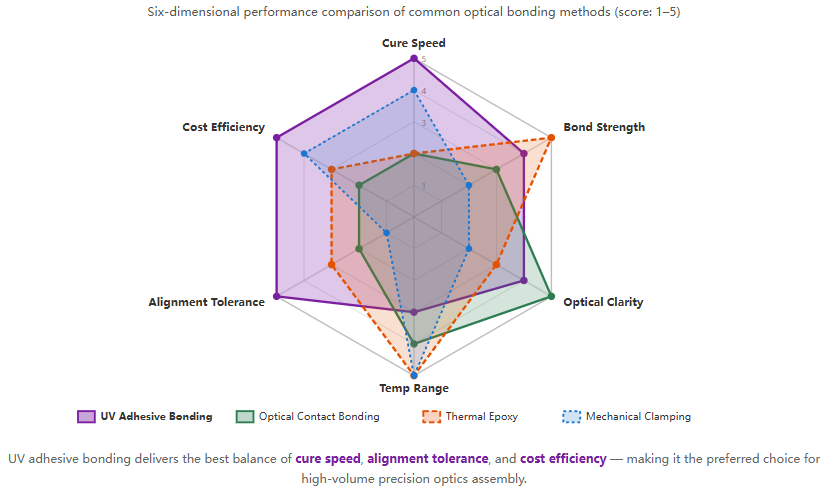
Bonding Method Comparison