What Is CNC Drilling?
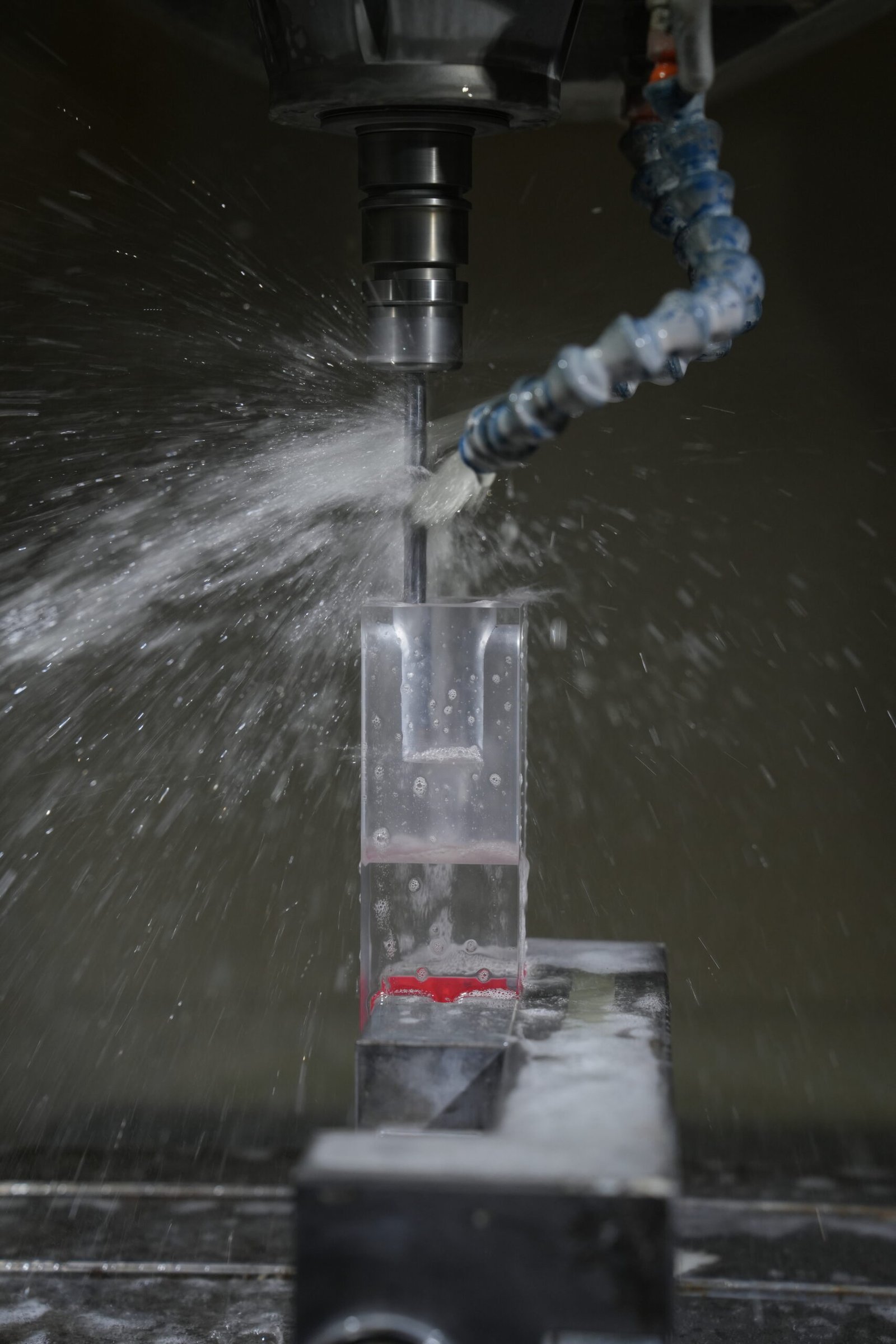
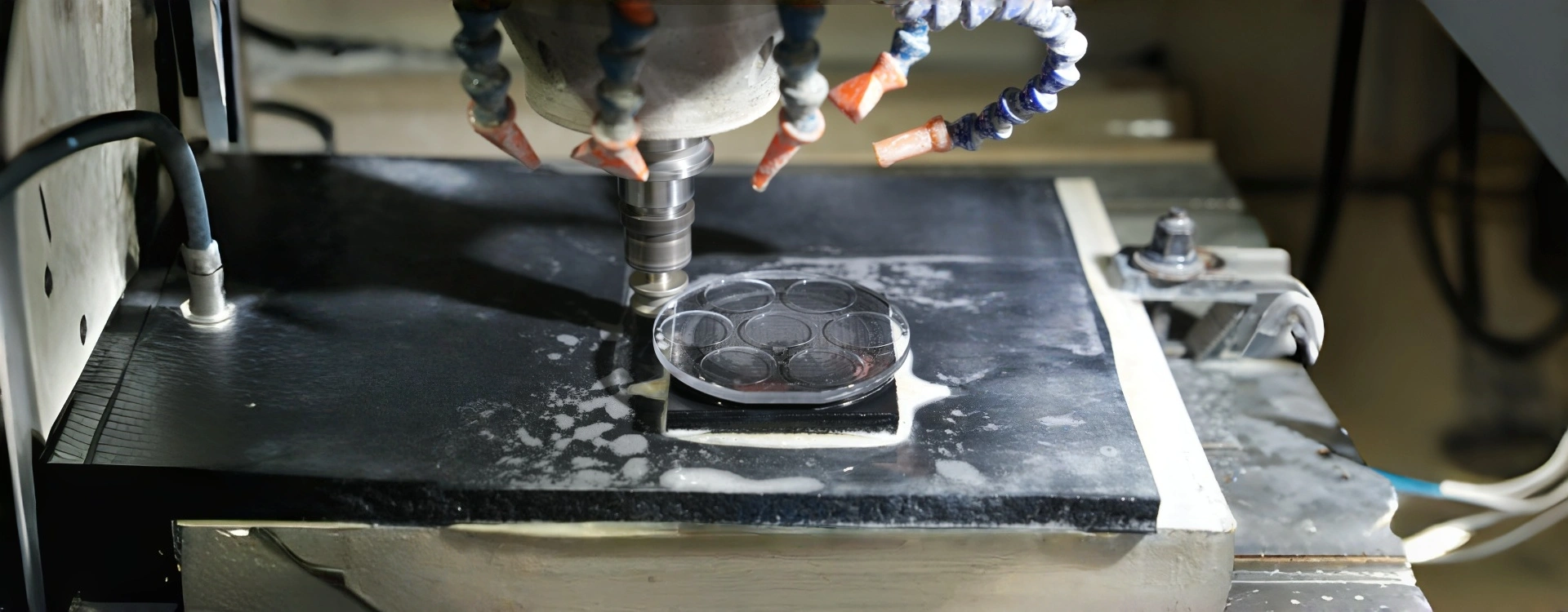
CNC drilling for glass and optical substrates is a precision machining process that uses diamond-plated or diamond-sintered drill bits mounted on high-rigidity CNC machining centers to create through-holes, blind holes, counterbores, and countersinks in brittle materials. Unlike metal drilling, glass drilling relies on abrasive grinding rather than shear cutting — the diamond grit gradually removes material while continuous coolant flushes chips and prevents thermal damage. Modern 5-axis CNC platforms allow simultaneous positioning and drilling at arbitrary angles, producing clean, chip-free edges with position accuracy to ±10 µm. The process is essential for microfluidic devices, optical mounting substrates, display glass, and semiconductor carriers where holes must integrate seamlessly with other precision features.
Process Capabilities
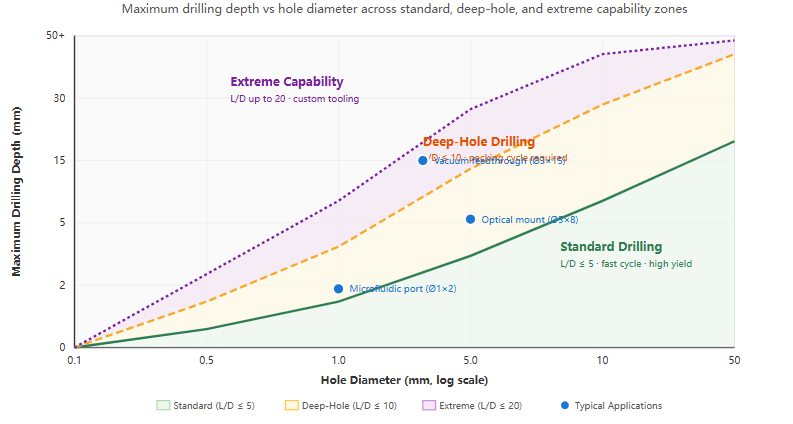
- Hole Diameter Range: 0.3 mm – 50 mm (standard); down to 0.1 mm (micro-drilling)
- Diameter Tolerance: ±5 µm (precision); ±20 µm (standard)
- Position Accuracy: ±10 µm across full substrate
- Depth-to-Diameter Ratio: Up to 20:1 (with pecking cycle and coolant)
- Maximum Drilling Depth: 30 mm (standard); 50 mm (custom fixturing)
- Hole Types: Through-hole, blind hole, counterbore, countersink, tapered
- Drilling Angle: 0° – 90° (5-axis capability)
Compatible Materials
| 1 | Fused Silica | Corning 7980 / Tosoh ES-2000 |
| 2 | Quartz Glass | SCHOTT Lithosil Q / Heraeus Suprasil 1 |
| 3 | Borosilicate Glass | PYREX 7740 / BOROFLOAT 33 |
| 4 | Soda-Lime Glass | Float / Tempered |
| 5 | Sapphire | C-plane / A-plane |
| 6 | Glass-Ceramic | ZERODUR / PYROCERAM 9606 |
| 7 | Optical Glass | BK7 / N-BK7 |
| 8 | Technical Ceramics | Al₂O₃ / AlN / Si₃N₄ |
| 9 | Silicon | Float Zone / Czochralski |
| 10 | CaF₂ | UV-grade / IR-grade |
| 11 | Germanium | Single crystal / Polycrystalline |
Edge Quality & Finish
- Entry/Exit Chipping: ≤ 50 µm (standard); ≤ 20 µm (precision, with backing plate)
- Hole Wall Roughness (Ra): 0.8 – 1.6 µm (as-drilled); 0.1 µm (post-polished)
- Edge Chamfer: Optional C0.1 – C1.0 chamfer on both faces
- Roundness: ≤ 5 µm (standard); ≤ 2 µm (precision ground bore)
- Perpendicularity to Surface: ≤ 0.05° (5-axis corrected)
- Post-Process Options: Edge polishing, chemical etching, AR coating compatible
Typical Applications
- Microfluidic Devices: Inlet/outlet ports for lab-on-chip and biochip substrates
- Optical Mounting Plates: Mounting holes for precision optical assemblies
- Semiconductor Carriers: Vacuum chuck holes and pin-lift holes in quartz wafers
- Display Glass: Speaker cutouts, sensor holes, and mounting features
- Laser Components: Coolant channels and gas ports in laser cavity parts
- Scientific Instruments: Vacuum feedthroughs and optical alignment holes
Custom Specifications
We accept custom CNC drilling orders for both prototype and high-volume production, with tolerance grades adjustable to application requirements. Custom parameters include hole pattern layout, angled drilling, stepped holes, and integrated machining workflows combining drilling with contouring, slotting, or edge profiling in a single setup. Post-drilling services — including edge polishing, ultrasonic cleaning, AR coating, and dimensional inspection with CMM reports — are available as part of a complete processing package. All drilled parts are delivered with full dimensional documentation and material traceability.
Drilling Capability: Hole Depth vs Diameter