What Is CNC Milling?
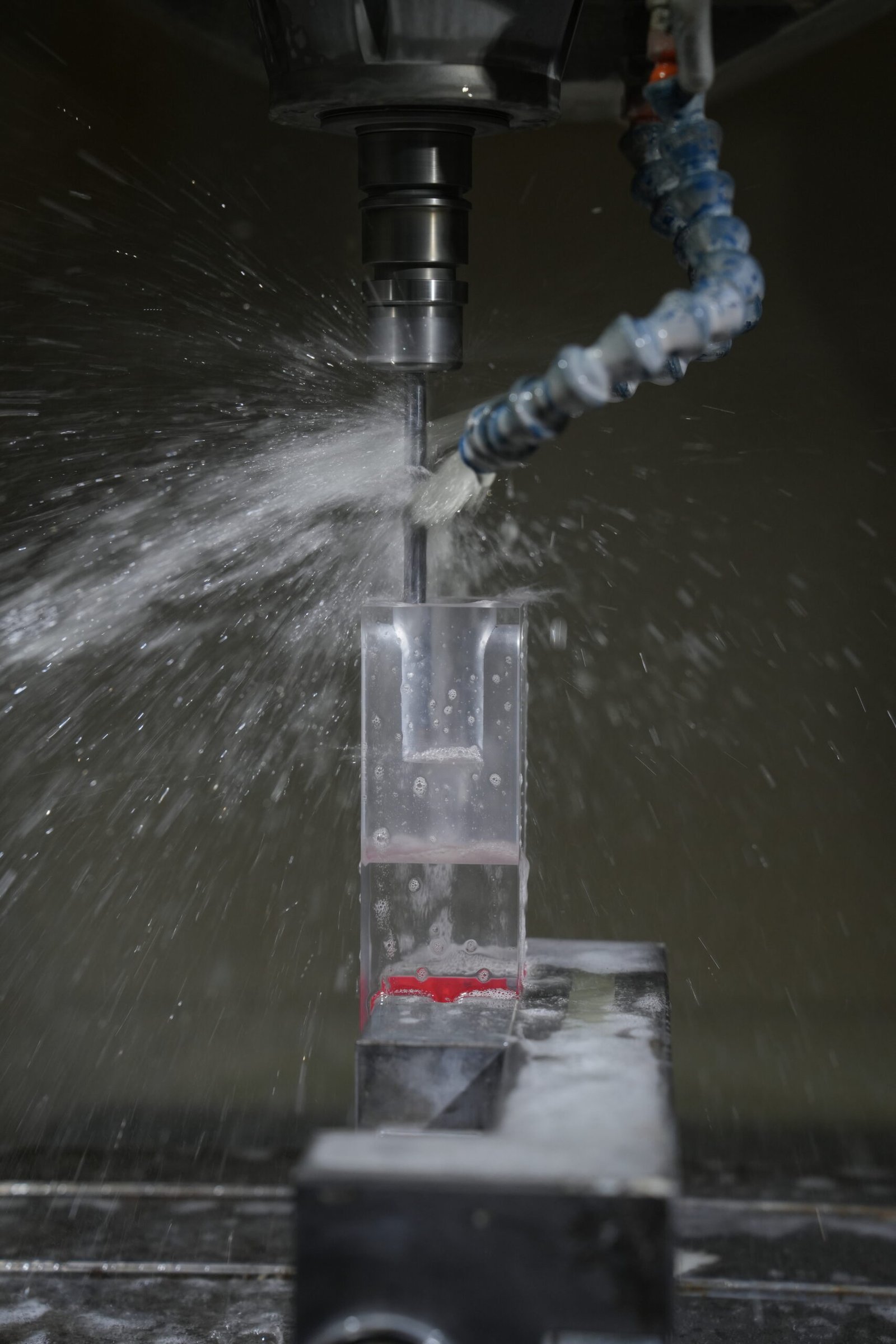
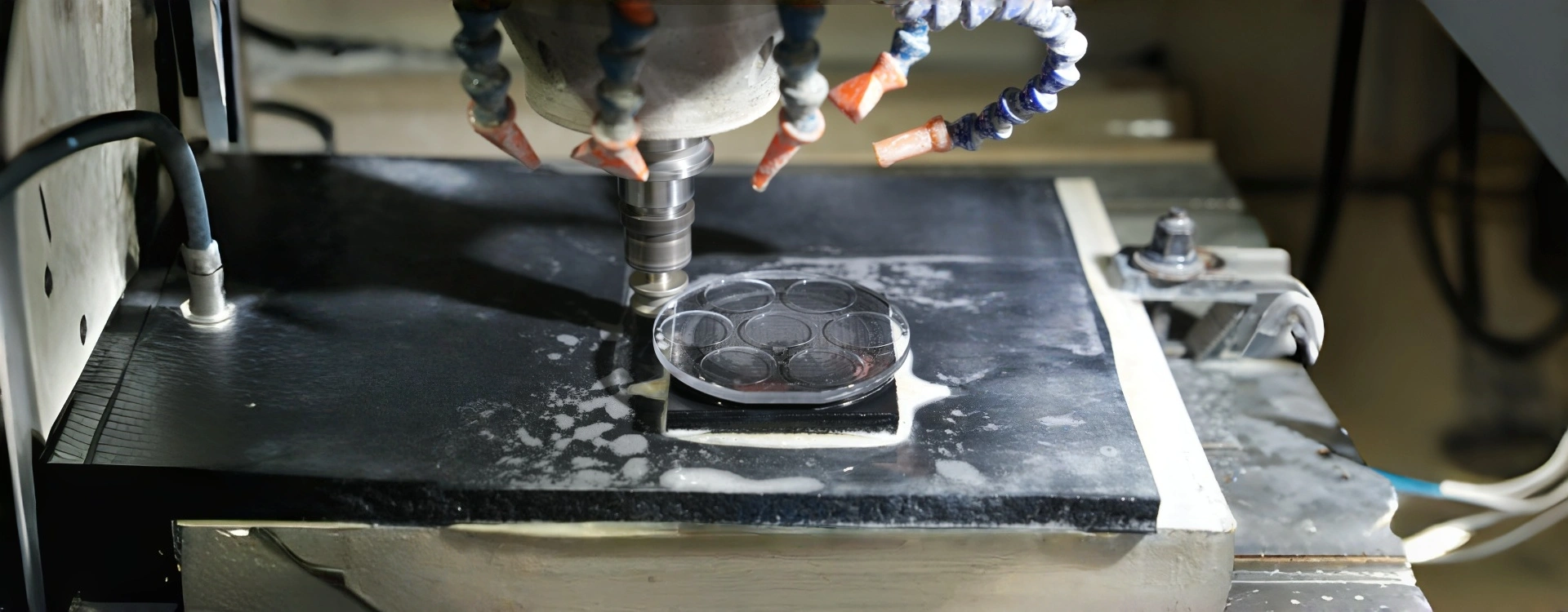
CNC milling for glass and brittle materials is a subtractive machining process that uses rotating diamond-coated or diamond-sintered cutting tools to remove material and create complex 3D geometries — including pockets, channels, steps, chamfers, and freeform surfaces. Unlike conventional metal milling where tools shear material, brittle-material milling relies on controlled micro-fracture and abrasive grinding at the tool-workpiece interface, with continuous coolant flow to flush debris and prevent thermal stress. Modern 5-axis CNC platforms enable simultaneous multi-axis tool positioning, allowing undercuts, angled features, and freeform contours to be produced in a single setup. CNC milling is essential for microfluidic device fabrication, optical mount bodies, semiconductor process components, and any application requiring complex 3D features in hard, brittle substrates.
Process Capabilities
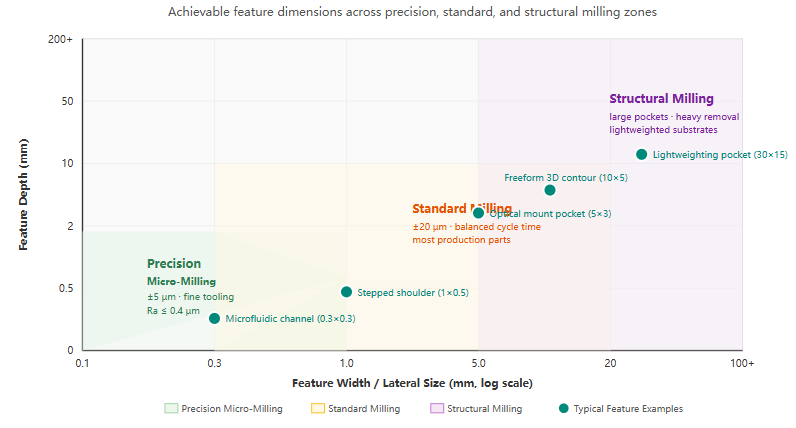
- Feature Tolerance: ±5 µm (precision); ±20 µm (standard)
- Minimum Feature Size: 0.2 mm wall thickness / 0.3 mm channel width
- Maximum Part Size: 500 × 500 × 200 mm (XYZ envelope)
- Position Accuracy: ±3 µm across full workpiece
- Axis Configuration: 3-axis, 4-axis, and full 5-axis simultaneous machining
- Surface Roughness (Ra): 0.4 – 0.8 µm (as-milled); 0.05 µm (post-polished)
- Repeatability: ±2 µm batch-to-batch
Compatible Materials
| 1 | Fused Silica | Corning 7980 / Tosoh ES-2000 |
| 2 | Quartz Glass | SCHOTT Lithosil Q / Heraeus Suprasil 1 |
| 3 | Borosilicate Glass | PYREX 7740 / BOROFLOAT 33 |
| 4 | Soda-Lime Glass | Float / Tempered |
| 5 | Sapphire | C-plane / A-plane |
| 6 | Glass-Ceramic | ZERODUR / PYROCERAM 9606 / MACOR |
| 7 | Optical Glass | BK7 / N-BK7 |
| 8 | Technical Ceramics | Al₂O₃ / AlN / Si₃N₄ / ZrO₂ |
| 9 | Silicon | Float Zone / Czochralski |
| 10 | CaF₂ | UV-grade / IR-grade |
| 11 | Germanium | Single crystal / Polycrystalline |
Feature Types & Geometry
- Pockets & Cavities: Flat-bottom, stepped, and freeform recesses down to 0.3 mm wide
- Channels & Grooves: Straight, curved, and serpentine channels for microfluidics
- Steps & Shoulders: Multi-level features with sharp or radiused transitions
- Chamfers & Fillets: Edge conditioning from C0.1 to C5.0
- Freeform Surfaces: 3D contoured surfaces for lens mounts and optical housings
- Undercuts: Full 5-axis undercut machining with side-mounted tooling
- External Contours: Complex perimeter profiling and non-rectangular outlines
Typical Applications
- Microfluidic Chips: Serpentine channels, mixing chambers, and reagent wells
- Optical Mount Bodies: Precision lens barrels and mirror mounting substrates
- Semiconductor Carriers: Wafer-handling jigs with vacuum channels and alignment pockets
- Laser Cavity Components: Coolant channels and mounting features in fused silica
- Aerospace Optics: Lightweighted mirror substrates with pocket-milled back structures
- Scientific Instruments: Custom chambers, flow cells, and feedthrough housings
Custom Specifications
We accept custom CNC milling orders from single prototypes to production batches, with full support for CAD-driven manufacturing based on STEP, IGES, or native CAD files. Custom workflows include integrated operations combining milling with drilling, contouring, and slotting in a single setup, as well as post-machining services such as edge polishing, chemical etching, AR coating, and full CMM inspection. All milled parts are delivered with dimensional reports, surface roughness measurements, and material traceability documentation. For high-precision optical components, we also offer post-milling lapping and polishing to meet λ/10 surface figure requirements.
Milling Capability Map: Feature Size vs Depth